Tuesday, September 29, 2009

Fabric-based Replication In the News


A recent Storage Magazine story addresses network or Fabric-based storage management including Replication. The article, "The pros and cons of network-based data replication" by Jacob Gsoedl specifies, "Network-based replication combines the benefits of array-based and host-based replication. By offloading replication from servers and arrays, it can work across a large number of server platforms and storage arrays, making it ideal for highly heterogeneous environments."

The writer clearly gets the core benefit of fabric apps for enabling the management of mixed storage environments. It cites a number of replication and virtualization products including EMC RecoverPoint, IBM SVC and HP SVSP.

To learn more of the specific features and benefits of a leading fabric-based replication offering, go to www.RecoverpointonBrocade.com.

Monday, September 28, 2009

The Golden Age of Fabric Apps


I found myself describing Fabric Applications as being in their "Golden Years" the other day. For being completely off-the-cuff, it's not a bad description. They are very mature and in that sense, people understand what they are and the value they bring. For instance, Network-based storage virtualization is still written about as an efficient approach to deliver the benefits of virtualization across a cross-vendor or heterogeneous storage environment.

Having said that, we're seeing more developments in array-based storage such as FCoE. And we can continue to expect more virtualization and replication capabilities consolidating onto the array, esp. with new modular designs like V-Max. Network-based offerings from IBM SVC and HP SVSP seem to defy this trend but those roadmaps should converge towards the DS8000 and EVP respectively at some point, as HDS offered the market solid validation of array-based heterogenous virtualization with the USP-V.

Don't get me wrong - I'm not sounding the death knell of network-based storage services. I'm guessing just the opposite: more intelligence being built into converged networks leveraging advanced standards such as FCoE, CEE and TRILL. And also continuing to provide common data management services and offload that allow applications using the fabric to be that much more efficient.

So for now, in addition to fabric apps, I'll be spending more time in the cloud space. Please follow the conversation on my new CloudItch blog (www.clouditch.com).

Tuesday, April 14, 2009

Congrats on V-Max


EMC had big news today thanks to their virtual launch of the new Symmetrix V-Max. It has garnered broad industry coverage, as well as its share of competitive brickbats.

It's a revolutionary break from the old-line monolithic array. Based on x86 components, designed with modular 'engines' to enable more granular scale-out, and built-in automated tiering makes it more like an offering from a nimble innovator like Compellent or 3Par. But with scale-up to a claimed 3PB and "tens of millions of IOPS" this is still gold-tier enterprise storage.

EMC's Chuck Hollis paints a typically empassioned view of the technology. It includes storage virtualization features such as pooling data across multiple arrays, non-disruptive data mobility and I/O load-balancing. He listed architectural approaches customers have to achieve Storage Virtualization: "today, we've got three different approaches to putting storage virtualization in the network: (1) use a server appliance (e.g. IBM SVC), (2) use an array controller (e.g. HDS USP), or (3) use an intelligent switch (e.g. EMC Invista)." Forgiving the over site of "host-based" (e.g. DataCore), this list does cover the typical enterprise, large service provider or government agency considered set. There are a number of choices each with its pros and cons.

And despite all the greatness of V-Max, the Storage Virtualization buyer often needs to address issues of heterogeneous storage resources, performance and vendor lock-in. Where these are issues, a fabric-based approach is still the best way to go. (And if you're an EMC shop, you can still make your sales rep happy by choosing Invista.)

Congrats to the Symmetrix team on the launch -- we're all eager to see how the new V-Max vision rolls out over the coming months.

Friday, April 10, 2009

Virtual Storage as well as Coffee Cups


The report from SNW: still a big show but not quite as large as last year. Cost cutting was top of mind, with one attendee sharing that his company eliminated styrofoam coffee cups to save $70k!

Storage news included the apparent maturing of Storage Virtualization, with 76% of attendee orgs either having already deployed or expecting to deploy a solution by next year. Companies are realizing savings from Storage Virtualization through efficient resource pooling, reduced management complexity and the ability to manage more data with the same staff. One company shared that they had 15PB all on a performance SAN, and wanted to reduce cost through tiering to cheaper arrays -- a compelling use for Storage Virtualization.

With the maturing of the category, the key players will stabilize their respective positions. But there's a potential disruption on the way, because the market still hasn't found an equilibrium in terms of form-factor, with shares split between array-based (e.g. HDS USP), appliance-based (e.g. IBM SVC and NetApp V-Series), Host-based (e.g. Datacore) and Fabric-based (e.g. EMC Invista). Expect to see innovation in how network-based technology works to improve the performance of these and other storage apps...

Friday, March 6, 2009

Pay-as-you-go Computing

It's exciting to see as both vendors and customers become more evolved with this IT business, that the nature of our transactions change. The recent buzz about the expected explosive growth in Cloud computing has not-surprisingly coincided with continued IT cost reduction pressures. Some is certainly due to the current global economic crisis, but the trend has been in play for a long time. What has gone from an exercise in procuring something cool and breakthrough, has become buying something basic and vital, like milk. I've taken a stab at capturing some key aspects of this evolution to cloud computing.

What I'm seeing as especially significant is how we as infrastructure technology providers are going to have to package our solutions in a more pay-as-you-go fashion. Very much like how we all buy our power at home - it sounds like a no-brainer, but let's say you make your living selling network hardware. How does that work? And as the customer, what do you expect this utilization-based arrangement to look like? Or maybe the real takeaway is that you don't want the arrangement at all. You want email, a way to track your sales pipeline, and a means to do book-keeping, and don't want to have to staff experts to determine if the best way to do this requires Fibre Channel, Ethernet, FCoE, CEE, or M-O-U-S-E.

Wednesday, March 4, 2009

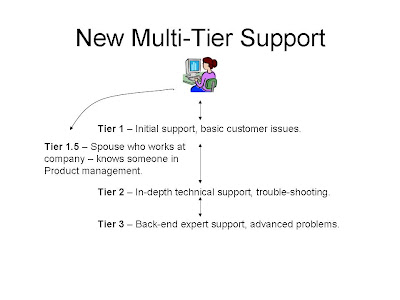
The New Multi-Tier Support Model

First of all, I want to give credit where it's due. Intuit redeemed themselves and found our lost TurboTax Online 2007 return. I didn't think it was really deleted or inaccessible. Even though their support person did.

The real story is their breakthrough Customer Support model. It leverages a typically un-tapped resource: the spousal network. After being told 'Sorry' by the Support rep, I shared my frustration with my wife, who works at Intuit, and 24 hours later the problem is solved. Why waste expensive call-center resources when you can just have a spouse help solve customer problems? It worked for Intuit, and it can for you, too.
Step 1. Operationalize the new support model, see diagram.

Step 2. Require your employees to marry your customers. May require some convincing, and depending on company size, polygamy, but you can achieve anything with the right attitude.

Saturday, February 21, 2009

Setting back network-based computing one return at a time

There are many advantages to running applications on a network, like not having to worry about an operating system, eliminating your local host footprint, etc. But there's a big unspoken but widely understood issue: it's trust. You need to be able to trust that things will work just as well on the network as they would on your local server. You hand-over control and therefore accept some risk in exchange for the benefits. The overall function should net benefits to the customer.

Back in the early days of 'cloud computing' circa 1999 when we were running client-server apps like Exchange straight over public IP, customers were taking trade-offs in performance but conscientious ASPs more than delivered in terms of cost savings, availability and reliability. The last thing you wanted to do was make things on balance worse for the customer. And the ABSOLUTELY last thing you wanted to do was lose someones data even if it was 'just email'.

Well, fast foward a decade later. Here's a $3 billion so called leader in personal finance software, Intuit, with thier leading tax prep solution, Turbotax, trying to remain relevant within a growing market of online personal finance and related alternatives such as mint.com, wesabe.com , and others, many founded by Intuit alumni. These startups get that the key to the battle is in building trust. Well, let me tell you, if you are trying to build trust in an online business, you don't do it by losing someone's data.

I just got off a call with the Turbotax support line, because the help page directions I had been following to access a previous years return didn't seem to work. After spending 30 minutes waiting for an answer (this is actually the average hold time) and another 20+ on the phone with support, I'm told that the 2007 to 2008 conversion I had attempted, per the online help instructions, can only work once. If it didn't work the first time then your tax data has been deleted.

Never in my years of experience with various forms of online-based services would I ever have expected to encounter a system that would, by default, delete customer data. I wouldn't write an MRD for a program like that. I had never worked with an engineer that would code something like that. Nor do I recall a sys admin who would ever manage an environment where you couldn't recover data even if the program couldn't access it.

Not only is Intuit showing incompetance in application development, but by losing customer data they risk pulling down the entire industry. Whether you're doing online storage, CRM, ERP or security across the public cloud or within a private cloud, we absolutely must be stewards of the customer's data and ultimately thier trust. We strive to bring net benefits. But at the very least, even if you as a company are incapable of evolving yourself, even if you can't deliver customer value within an online model, then for the sake of those companies around you who will make it, please at least 'do no harm' and don't drag down the industry around you.